How Many Restrooms Does a County Fair Need?
Start with attendance, not gut feel. OSHA 1926.51(c) sets the baseline most planners still use as a reference point: one toilet for every 20 workers on a job site. A county fair isn't a construction site, but the same logic of matching fixtures to headcount holds. A fair pulling a few thousand people over a weekend usually needs a mix of standard units and at least one accessible unit per cluster, since ADA Standards section 213.2 requires at least 5 percent of any grouped set of single-user toilets to be accessible, never fewer than one.
Layout matters as much as count. ANSI/PSAI Z4.3 sets a baseline service interval of once per week for up to 10 steady users over a 40 hour stretch, but a fairground with midway traffic runs hotter than that and needs servicing built into the event schedule, not left to the standard. We place clusters near food vendors, near the midway, and near the grandstand separately, so no one is walking the length of the fairground to find a door. If your fair runs near Lakewood, about 7.9 miles west of Cleveland, or out toward Parma, 10.4 miles south, we already know the load-in patterns for fairground turf and gravel lots.
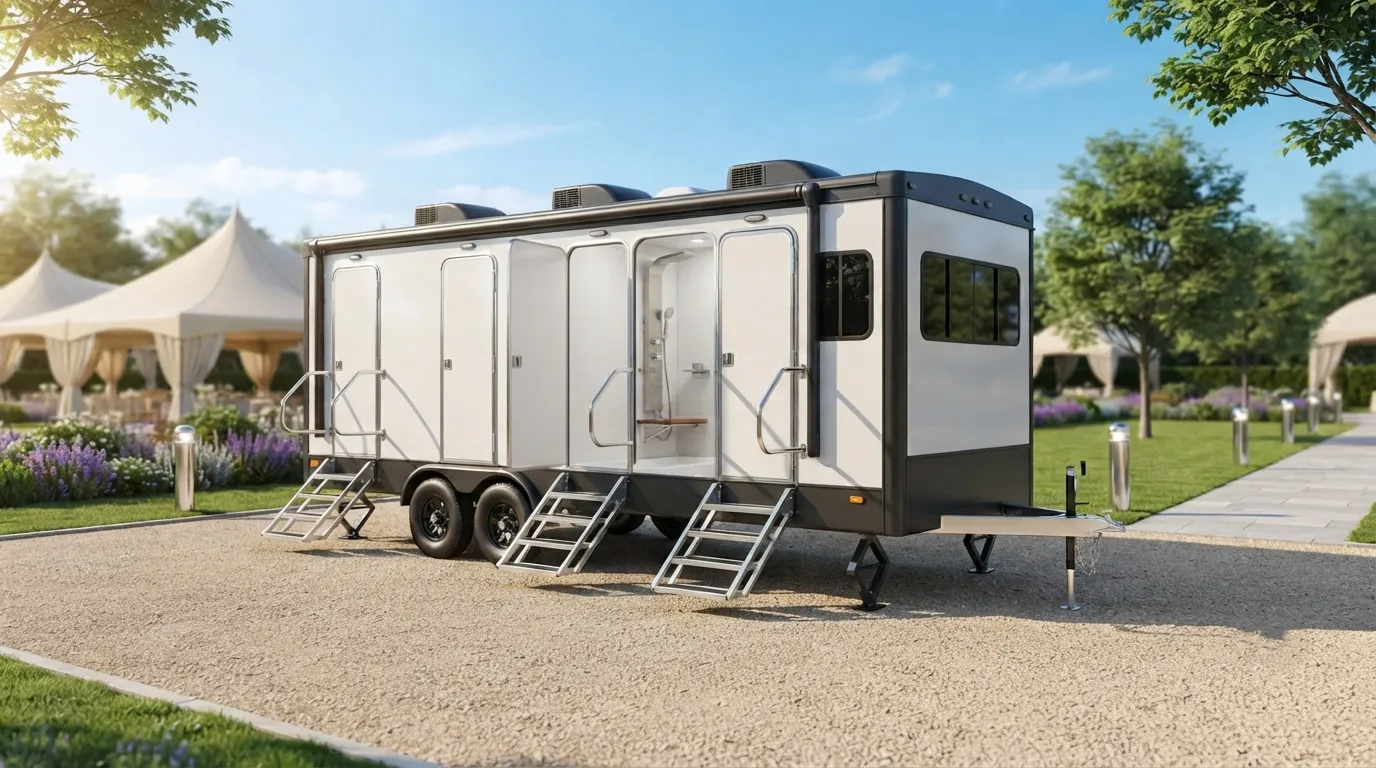
A standard unit runs 44 by 48 inches on the ground and stands about 92 inches tall, small enough to tuck along a fence line without blocking foot traffic. For fairs expecting a heavier draw, an 8 stall restroom trailer or a 4 stall restroom trailer cuts the line at peak hours far better than a wall of single units. Pair either with a handwashing station rental near the food court, since fairgrounds with fried food vendors and livestock barns both push handwashing demand hard.
What Should Be Included in a Fair Restroom Package?
A fair package should include standard units, at least one ADA-compliant unit per cluster, and handwashing stations positioned near food and animal areas. Add a deluxe flushable porta potty or two near VIP or sponsor tents if your fair sells premium tickets.
Every accessible unit we place meets the physical minimums that matter on show grounds: ADA Standards section 404.2.3 calls for a 32 inch clear door opening, and ADA Standards section 304.3.1 requires a 60 inch turning circle inside. We check ground surface too, since fairground turf and packed gravel both need to meet the stable, firm, slip resistant standard under ADA Standards section 302.1. If your midway sits on a slope, ramps into any trailer unit need to hold to a 1:12 running slope under ADA Standards section 405.2, which we build into the trailer leveling plan before delivery day.
Handwashing counts as its own line item, not an afterthought. 29 CFR 1910.141(d)(2) requires soap and towels or a hand drying device at wash stations; hand sanitizer alone does not satisfy that standard, and fair health inspectors know the difference. If your fair includes a petting zoo, livestock barn or 4-H area, plan for more handwashing capacity than the midway alone would suggest. We also stage temporary fence rental around service areas and generator zones, and a light tower rental if your fair runs into evening hours after the sun drops.
For multi-day fairs, a storage container rental or mobile office trailer rental gives fair staff a secure spot for cash boxes and supplies overnight. Waste from food vendors adds up fast too, so most fairs pair restroom service with a roll-off dumpster rental sized to the vendor count and fair length.
When Should I Book Restrooms for a Cleveland County Fair?
Book as soon as your gate dates and expected attendance are set, ideally 60 to 90 days out for a multi-day fair. Fairground season overlaps with wedding and festival season across Cleveland, and units, trailers and fencing all get reserved early. If you're planning a fair near Cleveland Heights, 7.8 miles east, or Euclid, 14.4 miles northeast, we can walk the site and confirm turf access, generator placement and delivery clearance ahead of your first vendor meeting. A roll-off delivery needs about 60 feet of straight clearance behind the truck, which matters if your fairground has a narrow gate or a single access road.
Use our porta potty rental checklist or the broader how many porta potties do I need guide to nail down your count before you call. For full event planning, see event restroom rental and festival restroom rental, both close cousins of a county fair layout. You can also start with a request a quote and we will build the count around your fairground map.
How many porta potties does a county fair need?
It depends on attendance and fair length, but most multi-day fairs run a mix of standard units and accessible units per ADA Standards section 213.2. A few thousand daily visitors usually calls for a dozen or more units split across clusters near vendors, the midway and the grandstand.
Do county fairs need ADA-accessible restrooms?
Yes. Any cluster of single-user portable toilets needs at least 5 percent accessible units, never fewer than one, per ADA Standards section 213.2. Doors need a 32 inch clear opening and a 60 inch turning circle inside, per ADA Standards sections 404.2.3 and 304.3.1.
Are handwashing stations required at a fair?
Fairs with food vendors or livestock areas should plan for dedicated handwashing, not just sanitizer. 29 CFR 1910.141(d)(2) requires soap and towels or a hand drying device at wash stations; sanitizer alone doesn't meet that standard.
How much does restroom rental cost for a county fair?
Standard units run 200 to 800 dollars for an event booking, depending on count and duration. Restroom trailers for multi-day events range higher; see restroom trailer rental cost for the full breakdown by stall count.
Can Cleveland Porta Pros service restrooms during a multi-day fair?
Yes. We build a servicing schedule around your gate hours rather than relying on the once-a-week baseline. High-traffic clusters near food and the midway get serviced more often across a multi-day run.
Next step
Get a delivery date
Tell us the address, the dates and the headcount. We size the order and confirm the route.